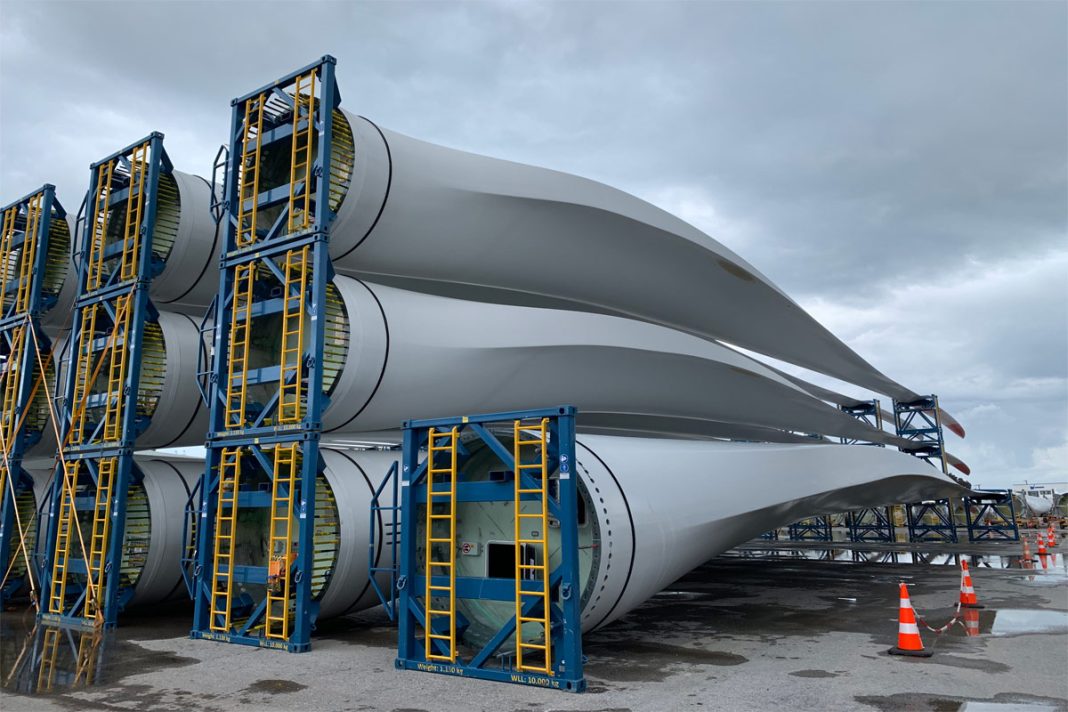
For decades, thermoset composites—think epoxy resins reinforced with fiberglass or carbon fiber—have been the gold standard for high-performance applications like wind turbine blades, aerospace components, and automotive parts. Their strength comes from permanent covalent crosslinks that make them durable and resistant to heat and solvents. But this permanence is also their Achilles' heel: once cured, they're nearly impossible to recycle, often ending up as landfill waste or downcycled into low-value fillers.
Enter cleavable bond chemistry, a transformative approach that redesigns thermoset polymers with built-in "weak points"—chemical linkages that can be selectively broken under mild, controlled conditions. This innovation is paving the way for truly sustainable composites, enabling disassembly and material recovery without sacrificing performance.
The Science Behind Cleavable Bonds
Traditional thermosets form irreversible networks. Cleavable bond chemistry introduces labile (breakable) groups into the polymer backbone or crosslinks, allowing the material to be depolymerized or dissolved when triggered by stimuli like mild acids, bases, heat, solvents, or even light.
Cleavable bonds fall into two broad categories:
Static Cleavable Bonds: Irreversibly broken, leading to permanent network breakdown.
Common examples include:
Esters: Hydrolyzed by acids/bases (e.g., in acetic acid solutions).
Acetals/Ketals: Highly selective acid-triggered cleavage, reverting to alcohols and carbonyls.
Disulfides: Broken by reducing agents for thiol exchange.

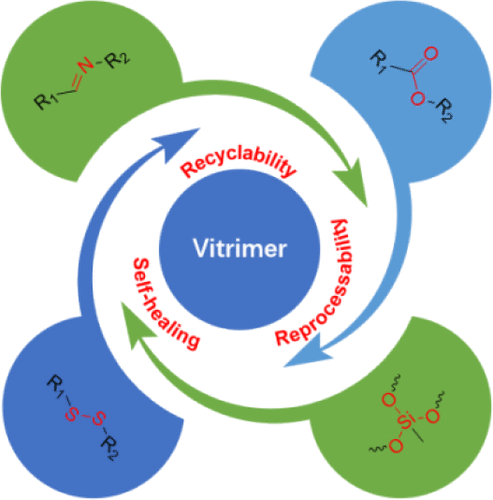
Dynamic Covalent Bonds (DCBs): Reversible and exchangeable, often forming the basis of advanced systems like vitrimers (more on those later). Examples: imines, boronic esters, and Diels-Alder adducts.
By incorporating just 5–10% of these cleavable monomers into standard resins, engineers create networks that behave like classic thermosets during use but dissolve or reprocess at end-of-life.
Recycling in Action
In practice, exposure to a trigger (e.g., a mild chemical solution at room temperature) selectively cleaves the bonds, swelling or dissolving the resin matrix while leaving reinforcement fibers intact and undamaged. High-value carbon fibers can then be recovered cleanly for reuse in new composites—preserving their length, strength, and economic value.
This is a game-changer compared to energy-intensive alternatives:
Mechanical grinding: Downcycles materials into fillers.
Pyrolysis: Requires high heat (400–600°C) and often degrades fibers.
Conventional solvolysis: Uses harsh conditions that consume significant energy.
Cleavable systems operate under ambient conditions, minimizing energy input and environmental impact.
Real-World Impact: From Wind Blades to Beyond
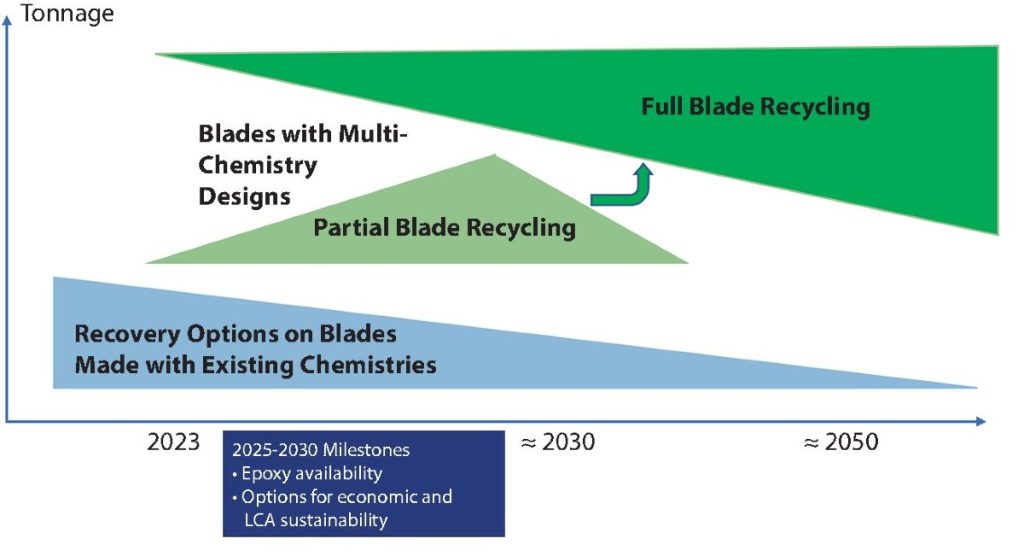
MingYang Smart Energy's MySE23X recyclable blade exemplifies this technology in action, using proprietary cleavable chemistry to enable full carbon fiber recovery. Similar approaches power Siemens Gamesa's RecyclableBlade (acid-cleavable epoxy for fiberglass) and research into bio-based resins.
Beyond wind energy, cleavable bonds are enabling:
Aerospace: Lighter, recyclable carbon fiber parts.
Automotive: Sustainable body panels and interiors.
Electronics: Reworkable adhesives and encapsulants.
As regulations tighten (e.g., EU mandates for composite recyclability), cleavable chemistry is bridging the gap to a circular economy, reducing reliance on virgin materials and cutting waste.
This is just the beginning—cleavable bonds often overlap with dynamic systems like vitrimers, which add self-healing and reprocessability for even smarter materials.
Next article topic: Vitrimers – The Polymer Class Combining Thermoset Strength with Thermoplastic Recyclability.