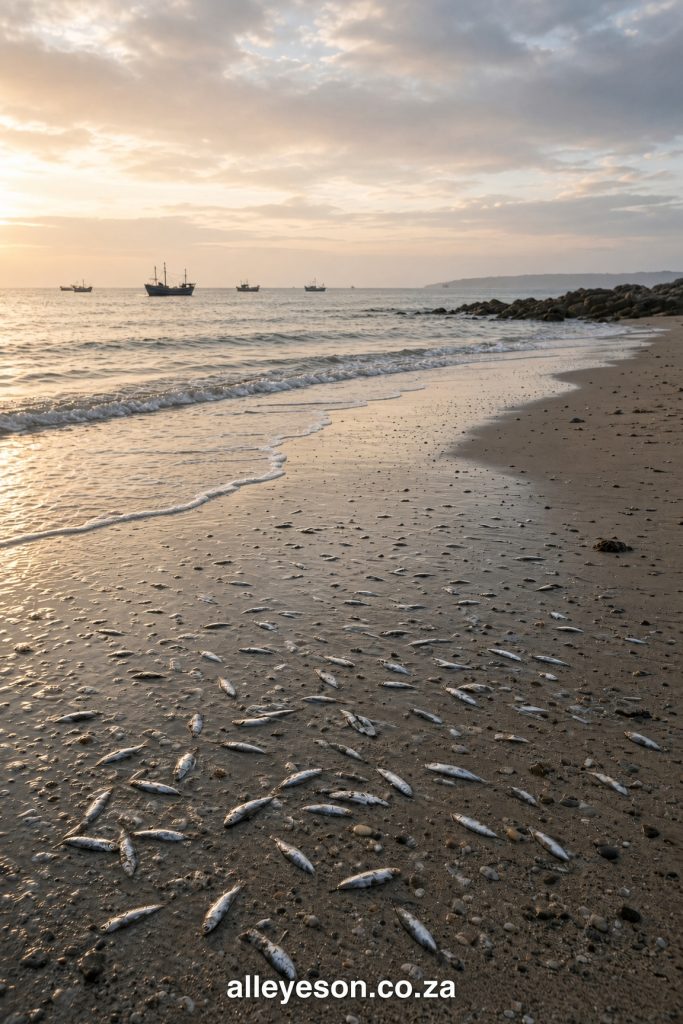
Along the West Coast this August, the beaches told a quiet, unsettling story. In places from Saldanha Bay down toward Gansbaai, and later as far as the Milnerton shoreline, sardines washed ashore in numbers that stopped people in their tracks. Dead fish drifted on the surface several nautical miles offshore near Hout Bay. For communities that live by the rhythm of the sea, the sight was impossible to ignore.
Scientists have now confirmed what many feared might be part of the picture. Laboratory sequencing has detected pilchard herpesvirus, or PHV, in sardines sampled along the West Coast. The virus was found in both dead fish and, at lower levels, in some that appeared healthy. This is the first time PHV has been reported in South African sardines.
The Department of Forestry, Fisheries and the Environment has been careful with its wording. The presence of the virus does not automatically explain the mass deaths. Officials note that the virus alone may not be enough to cause such widespread mortality. Environmental stressors low oxygen, unusual ocean conditions, or low-level algal toxins, are still under investigation as possible triggers that could have pushed already infected fish over the edge.
Tests have ruled out the most dangerous algal toxins linked to a harmful bloom in Saldanha Bay. Two other toxins were detected at low levels, but the highest readings came from a healthy comparison sample taken in St Helena Bay. The department says these findings make it unlikely that toxins were the primary cause.
Pilchard herpesvirus is not new to the world. It was linked to two large sardine die-offs in Australia and New Zealand in the 1990s. In later years the same virus was found in healthy Australian populations without continuous mass mortality. That history is important. It suggests the virus can exist in a population without always causing visible disaster, until other pressures tip the balance.
For West Coast residents the news carries particular weight. Sardines or pilchards, as many still call them, form part of the backbone of the small pelagic fishery that supports jobs from St Helena Bay through to the canning factories further south. The department has been clear that healthy commercially caught sardines and canned products remain safe. There is no evidence the virus infects people or other animals, and no general suspension of fishing or canning has been ordered. Standard food-safety controls continue.
Still, the first detection of a virus never before recorded in local waters raises longer questions. How did it arrive? Was it always present at undetectable levels, or did it enter through some other pathway? A 2016 scientific study had already warned that imported frozen sardines from regions where the virus is known could pose a risk of introduction. That possibility is now part of the conversation.
A task team is being formed that includes the department, the fishing industry and other stakeholders. Its job is to develop a coordinated response plan. The next major biomass survey, scheduled for October and November, will give scientists their first proper look at whether the local sardine population has been meaningfully affected.
On the beaches between Saldanha and Cape Town, the immediate drama appears to have passed. By early August the reports of fresh dead fish had largely stopped. Yet the finding of pilchard herpes virus leaves a quieter, more lasting unease. The West Coast has always lived close to the sea’s abundance and its sudden absences. This latest episode is a reminder that even familiar fish can carry new risks, and that understanding them will take time, careful science, and continued watching of the water.


