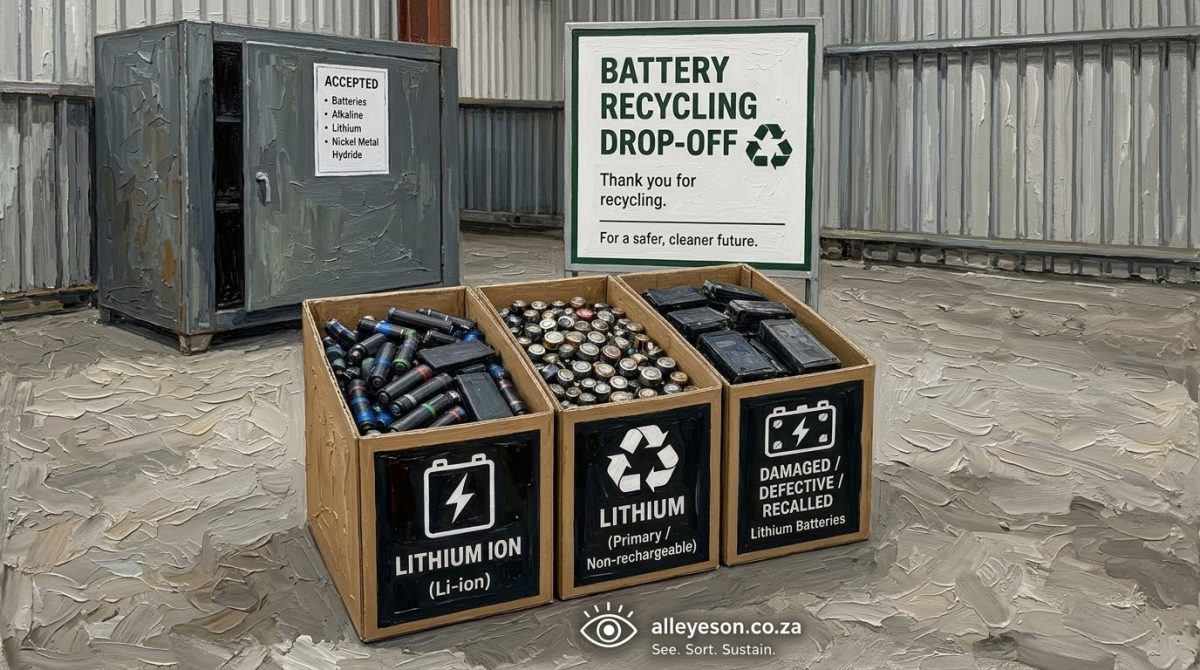


South Africa produces a steady stream of lithium-ion batteries from phones, tools, solar systems and backup power units. Many people are still unsure what happens once a battery leaves their hands.
The system is guided by the National Environmental Management: Waste Act and the Extended Producer Responsibility regulations. Producers and importers fund collection and recycling through registered Producer Responsibility Organisations such as eWASA. Targets are set in absolute tonnes. Formal collection currently sits in the lower range, around 7–12 %.


In the formal chain, producers pay fees to PROs, which work with accredited recyclers. Drop-off points include selected retailers, municipal sites and specialised facilities. Batteries are first discharged and made safe, then shredded into black mass. The black mass is processed to separate the metals. Lithium is recovered as lithium carbonate, currently valued at roughly R216–R249 per kilogram.
Local capacity is developing. Companies such as Desco, EWaste Africa, AST Recycling and Go Green handle general e-waste. Cwenga Lib in Germiston runs the first dedicated lithium-ion recycling plant in the Southern Hemisphere, using a room-temperature process with food-grade reagents.


A substantial portion of batteries still moves through the informal sector — street collectors, scrap yards and small-scale operators. This keeps material circulating in the short term, yet it carries risks of fire, uncontrolled processing and exposure for workers. Formal and informal channels remain only partially linked.
Compared with the European Union, South Africa’s framework is still maturing. The EU uses percentage-based targets, widespread free take-back points and tighter enforcement, which has produced higher formal recovery rates in several member states. South Africa has the legal structure in place; expanding convenient collection points and clearer pathways for material remain ongoing work.


For households and small businesses the practical steps are straightforward: keep lithium batteries out of ordinary bins, use approved drop-off points when possible, and store them dry and intact until they can be handed over. Proper handling recovers useful materials and reduces unnecessary risk.
The route from collection point to recovered lithium carbonate now exists inside the country. Using the available formal channels is the simplest next step.