The galjoen (Dichistius capensis), South Africa's national fish, is a sturdy, spirited fighter of the surf—a true emblem of the rugged Western Cape coast and the resilience of its people.
The name "galjoen" comes from the Dutch word for "galleon," the powerful 16th-century warships known for their broad sides, heavy cannons, and unyielding strength. Early observers saw the same qualities in this broad-bodied, tenacious fish that battles fiercely in rough waters—refusing to give up easily once hooked. Indigenous communities along the southern African coast had long known and harvested these fish, valuing them as a reliable food source in shallow, turbulent zones. By the 20th century, ichthyologist J.L.B. Smith and his wife Margaret recognized its uniqueness as an endemic species found nowhere else in the world. Margaret championed it as the marine equivalent of the springbok: iconic, exclusive to South Africa, and deeply tied to our heritage. Their efforts helped make it the official national fish.
The galjoen thrives along southern Africa's coast from southern Angola to KwaZulu-Natal, but it's most at home in the cooler waters of the Western Cape. It hugs shallow reefs, rocky outcrops, and the white-water surf zones—rarely venturing deeper than 10–20 meters. These slow-growing, long-lived fish (some reaching 20+ years) feed on red bait (ascidians), small mussels, barnacles, and crustaceans scraped from rocks and kelp. They change color masterfully for camouflage: near-black over reefs, paler silver-bronze over sand. Breeding peaks from October to March, often in slightly deeper water, with many starting life as females before becoming males (protogynous hermaphrodites).
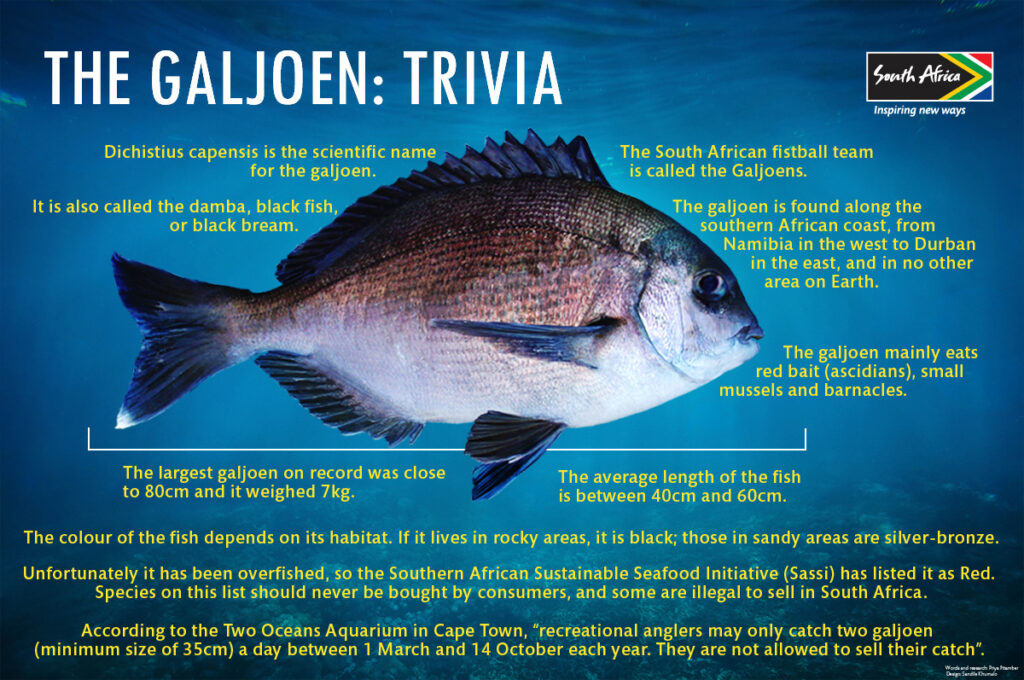
For anglers, the galjoen is legendary—a "game fish" that tests every ounce of skill in pounding surf. Rock and surf fishermen cast from rocky points along the Cape coast, using red bait or mussels on light tackle. The fight is fierce: powerful runs, head shakes, and dives into structure. Catches average 1–3 kg, though trophies over 5 kg are prized. Strict regulations protect it—minimum size 35 cm, bag limit of 2 per day, and red-listed status means no commercial sales, only recreational with a permit.
Culturally, the galjoen carries deep pride in Western Cape communities. It's grilled simply over open coals—often just seasoned with salt, pepper, and lemon—or turned into hearty dishes with onions and potatoes. The smoky aroma of a fresh galjoen braai signals good times: family gatherings, stories of epic battles with the tide, and quiet respect for the ocean's gifts.
Though overfishing has reduced numbers, conservation efforts keep this resilient fighter swimming. From the wild shores near Cape Point to the surf-pounded rocks of the Atlantic coast, the galjoen embodies endurance, heritage, and the unbreakable spirit of South Africa's coastal soul—a national treasure in every sense.


