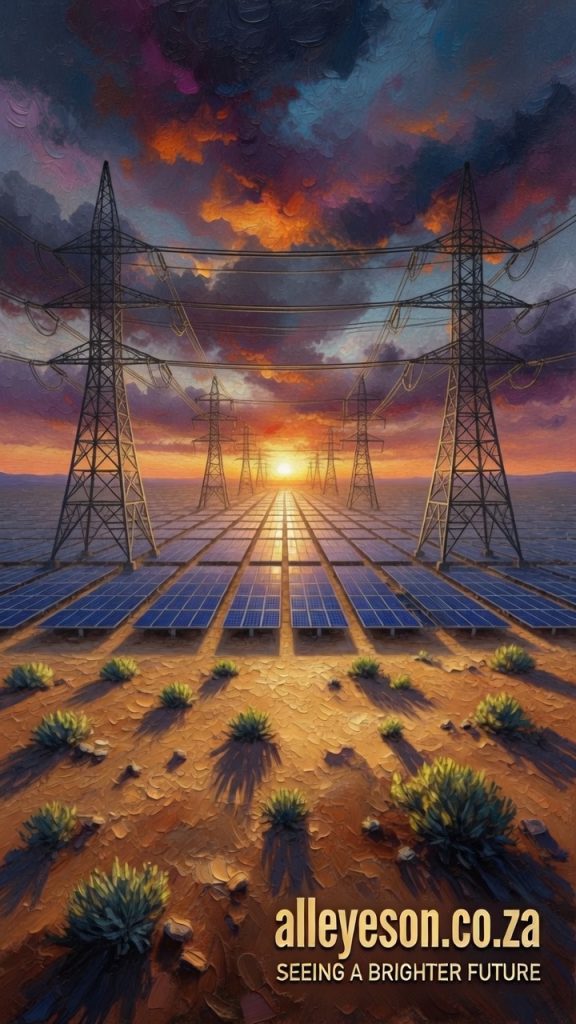
The engineering ambition behind China’s “Great Solar Wall” in the Kubuqi Desert is breathtaking. The project is planned as a continuous 400-kilometre-long corridor, averaging 5 kilometres wide, stretching across Inner Mongolia. When complete around 2030, it aims for a staggering 100 gigawatts of solar capacity — enough to power a major city like Beijing.

This is no ordinary solar farm. It uses advanced bifacial photovoltaic panels that capture sunlight from both sides, maximising output in the desert’s intense conditions. The panels are mounted on tracking systems that follow the sun’s movement throughout the day. To combat the harsh environment, frequent sandstorms, extreme temperature swings, and thick dust ,engineers have deployed robotic cleaning systems and durable panel coatings.
One of the biggest challenges is transmitting the power to where it’s needed. The electricity generated in the remote desert must travel hundreds of kilometres to eastern industrial centres. This is solved using Ultra-High Voltage Direct Current (UHVDC) transmission lines, which minimise energy loss over long distances. A major new 700km UHVDC line with 8GW capacity is currently under construction to carry power from the Kubuqi base to the Beijing-Tianjin-Hebei region.
The project also integrates energy storage and hybrid systems. Some bases combine solar with wind power and even limited coal capacity for grid stability. Battery storage and molten salt thermal storage technologies are being tested to ensure consistent power supply even when the sun isn’t shining.
Individual projects within the wall are themselves enormous. The Midong solar farm in Xinjiang, for example, boasts 3.5GW capacity using over 5 million panels. The Kubuqi bases often pair solar with ecological restoration, planting vegetation beneath the panels to combat desertification while generating power.
The sheer scale is difficult to comprehend, millions of panels, thousands of kilometres of cabling, and massive supporting infrastructure. It represents state-driven engineering at its most ambitious, backed by strong policy, cheap financing, and domestic manufacturing dominance.