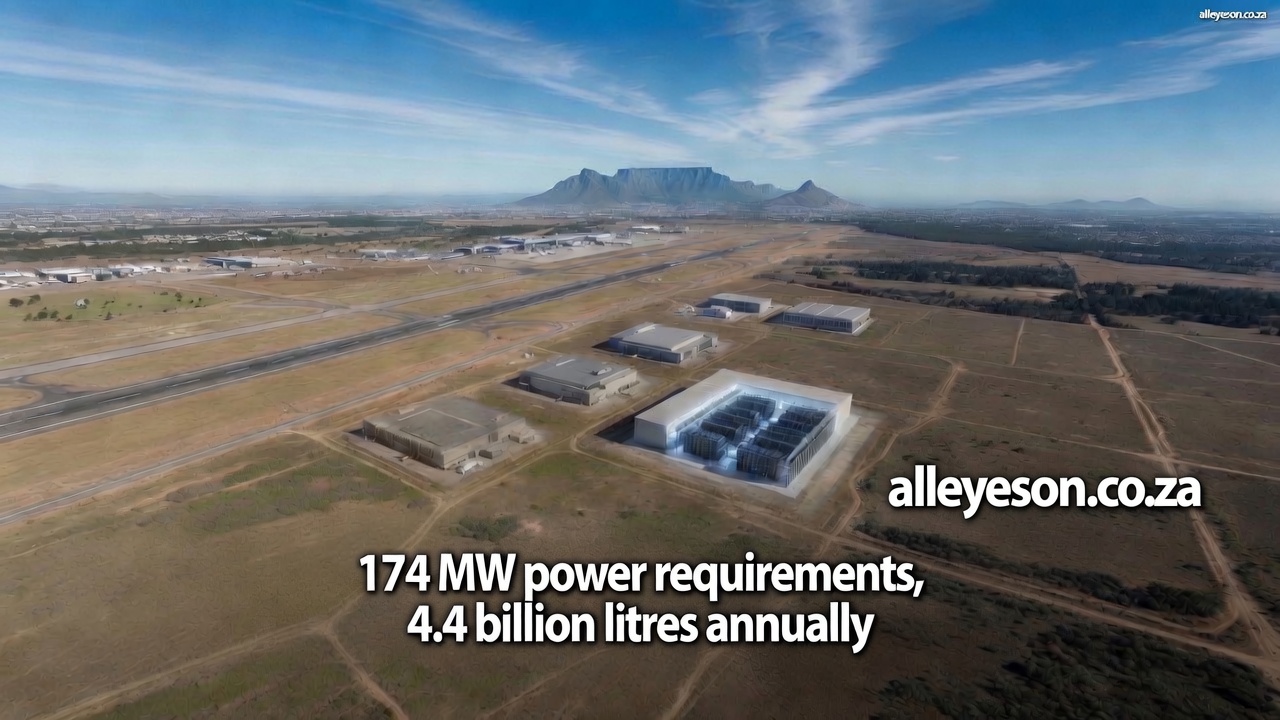

Imagine standing at your kitchen tap on a hot Cape Town summer afternoon and remembering the year we all watched every drop. The “Day Zero” posters. The buckets under the shower. The quiet fear that the city might run dry. Now picture two enormous buildings, each covering the area of several rugby fields, rising near the airport — and still no clear answer on how much water they will need.
That is the uncomfortable picture facing Cape Town this week.
The Cape Town Municipal Planning Tribunal has given initial approval for two new data centres in the Airport Industria area, on land linked to the King David Country Club and known as King Air Industria. The decision, taken by a 4–1 vote, allows the rezoning, subdivision and consolidation needed for facilities totalling more than 120,000 square metres. To put the scale in everyday terms, that is roughly the size of 14 rugby fields or 17 soccer fields of floor space near Pallotti Road and Cape Town International Airport.
US multinational Equinix is the company behind the proposed development. According to documents presented to the tribunal, the centres would have an electrical demand of around 174 MW, enough power, on paper, to supply more than 130,000 average homes. The project forms part of Equinix’s wider plan to expand its footprint in South Africa as demand for data storage and cloud services continues to grow.
What drew strong opposition was not the idea of new investment, but the missing details. The application did not specify how much water the centres would use for cooling. It also lacked clear information on energy supply arrangements, backup diesel generation, fuel storage, air pollution, noise levels and potential health impacts on surrounding communities.
The Housing Assembly, a Cape Town social movement representing residents in many low-income areas, and the UK-based tech justice organisation Foxglove lodged formal objections with support from the Legal Resources Centre. In presentations to the tribunal, Legal Resources Centre attorney Kimal Harvey pointed to research showing that a traditional water-cooled data centre can use about 25.5 million litres of water per year for every megawatt of capacity. Applied to a 174 MW facility, that figure climbs to roughly 4.4 billion litres annually — a volume that immediately raises red flags in a city still scarred by the memory of severe water shortages.
Foxglove described the lack of water and energy information as a “critical” gap and “particularly troubling.” Housing Assembly members reminded the tribunal that many of their communities had watched taps run dry during the Day Zero crisis of the previous decade. For them, the idea of prioritising large industrial water users without clear numbers felt like a risk the city could not afford to take lightly.
The tribunal’s decision is not the final word. The projects still require Site Development Plan and building plan approvals before any construction can begin. Equinix has stated that it has not yet submitted a formal application for the data centres themselves and has committed to greater transparency in the later stages of the process.

The deeper question Cape Town now faces is how to balance the genuine demand for digital infrastructure with the hard limits of water and power in a water-stressed, energy-constrained city. Data centres bring investment, jobs and the connectivity that modern economies need. Yet they also place new pressure on systems that ordinary residents already struggle to access reliably.
As the next rounds of planning unfold, the water question will not disappear. Residents who lived through the anxiety of Day Zero will continue to ask whether the city is protecting its most precious resource with the same urgency it applies to attracting global technology investment. The answer, for now, remains unfinished.