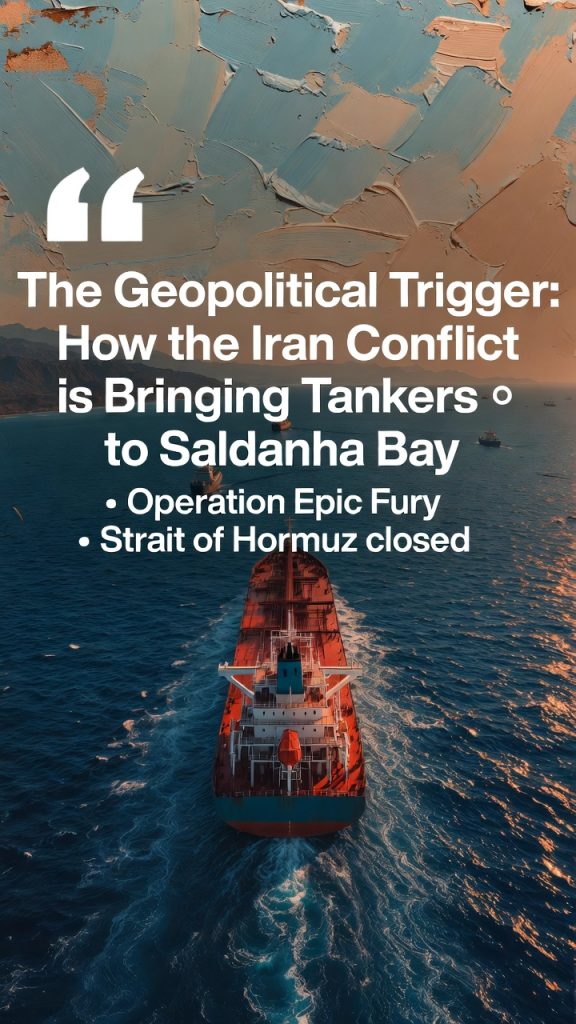
In late February 2026, a distant conflict thousands of kilometres away set off a chain reaction that is now bringing more giant tankers into Saldanha Bay than many locals have seen in years.On 28 February 2026, the United States and Israel launched Operation Epic Fury — a series of coordinated strikes targeting Iranian military sites, nuclear facilities, and leadership. Iran responded with missile and drone attacks on regional targets and, within days, its forces effectively shut down one of the world’s most vital shipping lanes: the Strait of Hormuz.
For residents on South Africa’s West Coast, this escalation explains the sudden surge of tankers stopping or passing through Saldanha Bay.The Strait of Hormuz: A Global Energy LifelineThe Strait of Hormuz is a narrow waterway, just 33 km wide at its narrowest point, between Iran and Oman. It is the only sea exit from the Persian Gulf.Under normal conditions, it carries about 20% of the world’s daily oil supply and a significant portion of global liquefied natural gas (LNG). Hundreds of supertankers loaded with crude from Saudi Arabia, the UAE, Iraq, Kuwait and Iran would pass through it every week on their way to markets in Asia, Europe and beyond.Any major disruption here sends immediate ripples through global fuel prices — including at South African petrol stations.How the Conflict Closed the StraitFollowing the start of Operation Epic Fury, Iran’s Islamic Revolutionary Guard Corps (IRGC) issued strong warnings and carried out attacks on vessels. By early March 2026, commercial traffic through the strait had collapsed.Normal daily transits: around 100–140 vessels.In the first weeks of March: traffic dropped by up to 90–95%, with some days recording near-zero commercial crossings or only a handful of vessels (often Iranian-linked).Major shipping companies reacted quickly to protect crews and vessels. Maersk, Hapag-Lloyd, and CMA CGM suspended all transits through the Strait of Hormuz and connected routes, including the Red Sea and Bab el-Mandeb Strait. Insurance providers withdrew war-risk coverage, making passage financially and physically too dangerous for most operators.Hundreds of tankers anchored outside the strait rather than risk missile, drone, or other attacks.
The Only Safe Option:
The Long Route Around AfricaWith the Middle East corridor effectively off-limits, shipping lines had one realistic alternative: rerouting vessels the long way around the Cape of Good Hope.This detour adds 10 to 20 extra days at sea and thousands of additional nautical miles compared to the usual Suez Canal route. Fuel consumption rises sharply, schedules are disrupted, and crews face longer voyages. Yet for the companies involved, it is currently the safer and more predictable path.The result has been a noticeable increase in maritime traffic along Africa’s southern and western coasts — including the waters off Saldanha Bay.Why Saldanha Bay Is Feeling the EffectsSaldanha Bay’s deep-water port and existing infrastructure for large vessels make it a practical stopping point for refuelling (bunkering), provisions, crew changes, or minor maintenance after the extended journey.What started as a geopolitical crisis in the Middle East has quietly turned parts of South Africa’s West Coast into a strategic support location for global shipping reroutes.Timeline of Escalation (Late Feb – Early April 2026)28 Feb: US and Israeli strikes begin (Operation Epic Fury).
Early March:
Iran declares restrictions and carries out attacks on vessels; commercial traffic through Hormuz plummets.1–5 March: Maersk, Hapag-Lloyd, CMA CGM and others suspend Hormuz and Suez transits and begin Cape reroutes.Mid-March onwards: Surge in vessels rounding the Cape; African bunkering hubs, including South African ports, see increased activity.April 2026: The situation remains fluid, with ongoing diplomatic pressure to reopen the strait.In the next article, we’ll look at The Cape Route Boom — the massive logistics behind the detour, the extra costs involved, and how this shift is reshaping global trade patterns right now.


