A British wheat farmer recently traced his grain from field to supermarket shelf and exposed a quiet truth: most industrial bread is not what the label suggests. South Africa uses the same system – and the same blind spots.
The Chorleywood Bread Process, invented in Britain in 1961, now dominates supermarket sandwich loaves here too. High-speed mixing, extra yeast, fats, enzymes and chemical conditioners turn weaker local wheat into soft, uniform bread in roughly two hours instead of the traditional overnight fermentation.
The result looks and tastes like bread, yet stays mould-free for 10 to 14 days. That longevity comes from preservatives such as calcium propionate and, since 2020, sorbic acid – both permitted under South African law.
The bigger issue is what you cannot see. South African regulations, like those in the UK, treat many enzymes, oxidising agents and dough improvers as “processing aids”. If the manufacturer claims they no longer perform a technical function in the finished loaf, they do not have to be named on the label. Only the broad category “preservatives” or “emulsifiers” may appear.
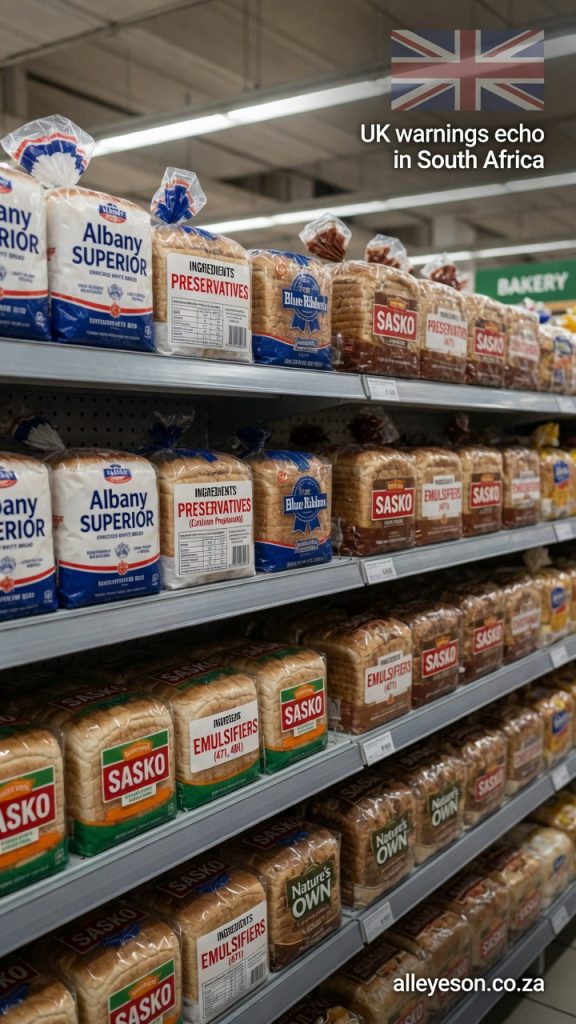
Recent studies have raised questions about some of these emulsifiers and their possible link to gut inflammation and metabolic changes. Potassium bromate, once a common dough improver, was banned in the UK decades ago over cancer concerns and remains restricted or prohibited in many countries – yet the regulatory focus here stays on declared additives rather than undeclared processing aids.
Local bakers and millers follow the same efficiency logic that swept Britain: lower-protein wheat, faster production, longer shelf life, lower cost. The consumer pays with less information and, potentially, with daily exposure to substances whose long-term effects are still being studied.
Real bread needs only flour, water, salt and yeast. Everything else is an industrial choice that the label often keeps hidden. South Africans deserve the same transparency the British farmer is now demanding for his own market.