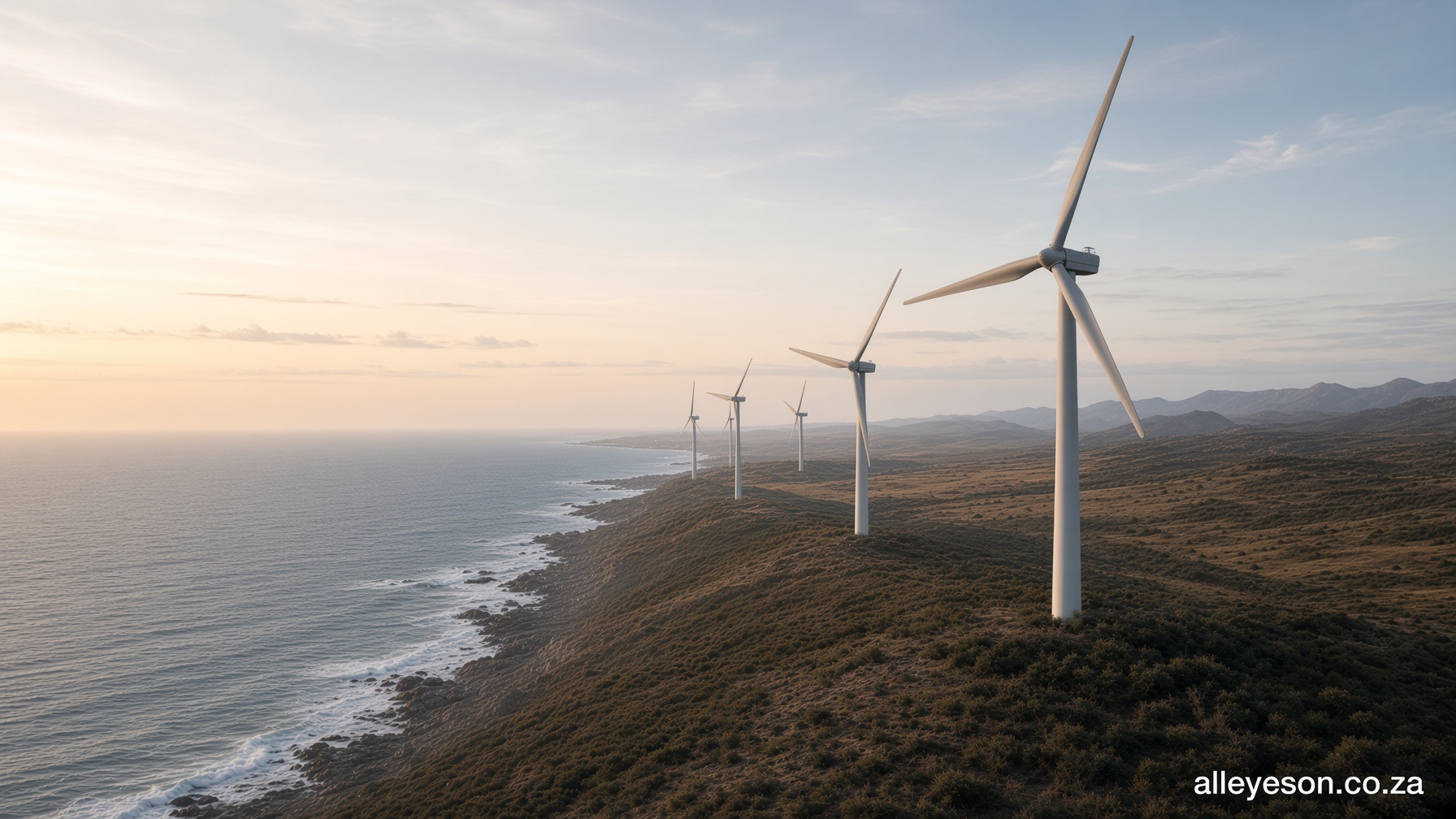

There is a quiet problem sitting in the future of South African wind energy, one that most people driving past the turbines near Darling or Saldanha do not yet see. Those long white blades that spin so cleanly against the West Coast sky will one day stop turning. When they do, the steel towers and concrete bases can largely be recycled. The blades themselves cannot. Made from fibreglass and epoxy resin, they are destined for landfill or, at best, low-value crushing into concrete filler. Across the world, the same story is playing out. By 2050, experts estimate that more than 50 million tonnes of blade waste will need somewhere to go.
A German startup has decided that this future is unacceptable. Voodin Blade Technology has replaced the fibreglass with something far older and far more circular: laminated veneer lumber, or LVL. Thin layers of wood, mostly Nordic spruce, are bonded under pressure into a high-performance engineered timber that is light, strong, and fully recyclable. In 2024 the company mounted its first full set of 19.3-metre wooden blades on a working turbine in the small German town of Breuna. Now, with a €48 million grant from the European Union’s Innovation Fund, Voodin and its partners are building the world’s first commercial factory for these blades in Navarre, Spain. Production is scheduled to begin in 2031.

The numbers attached to the project are striking. The factory is designed to produce up to 160 sets of blades a year, ranging from 20 to 90 metres in length. Over its first decade of operation it is expected to avoid more than 2.4 million tonnes of CO₂ equivalent. Manufacturing emissions are claimed to be 78 percent lower than conventional composite blades, and production costs roughly 20 percent cheaper. Because the process uses computer-controlled milling instead of fixed moulds, the same production line can switch between different blade designs without expensive retooling. Capital investment is estimated to be 54 percent lower than a traditional blade factory.
What makes the approach especially interesting for a country like South Africa is the end-of-life story. When a wooden blade reaches the end of its working life, it can be recycled into new timber products or even used again in the next generation of blades. The material stores biogenic carbon rather than locking plastic and glass fibre into the ground for centuries. In a world that is already struggling with the first wave of decommissioned turbines, this is not a small advantage.¶South Africa’s wind fleet is still relatively young, but the first commercial projects from the early Renewable Energy Independent Power Producer Programme will begin reaching the end of their design life in the 2030s. The West Coast and the Eastern Cape will feel that moment first. At present the country has no dedicated system for handling blade waste. Storage yards and landfills remain the default options. Europe is already experimenting with coordinated recycling programmes. Africa, as one recent industry analysis noted, is still operating without them. The arrival of a fully recyclable blade design therefore lands at a useful moment in the conversation.

There is also a deeper local resonance. South Africa has a long forestry tradition and a growing engineered-wood sector. The idea that high-value structural timber could one day form the primary material of wind turbine blades opens questions about future supply chains, skills, and manufacturing. While Voodin’s current process relies on Nordic spruce, the principle of laminated veneer construction is not limited to one species. If the technology proves itself at commercial scale, it could eventually travel. Factories designed for local production near wind farms would reduce transport costs and emissions — an attractive proposition for a country with long distances between ports and inland sites.

None of this means wooden blades will replace composites overnight. The wind industry is cautious, and certification for new materials takes time. Voodin still has to prove that its larger blades can match the fatigue performance and extreme weather resistance of the best fibreglass designs over decades of service. The Spanish factory will be the real test. Yet the direction of travel is clear. The industry can no longer treat the blade as a disposable component. Circularity is moving from aspiration to design requirement.
For readers on the West Coast, the story carries a particular quiet weight. The same Atlantic winds that power the turbines near Saldanha and Hopefield will one day have to deal with the physical remains of those machines. Watching a German startup and its European partners invest serious money in a fully recyclable alternative is a reminder that the clean energy transition is not only about generating electricity. It is also about what we leave behind when the spinning stops. Wood, it turns out, may have a larger role to play than anyone expected.

Allso read
Revolutionizing Wind Energy: The Dawn of Fully Recyclable Turbine Blades